Global financial panic, Sterling collapsing, and Scotland — possibly Northern Ireland, too — apt to break away. Quite a day’s work.
A striking aspect of the results is the extent to which the vote represents a victory of the old over the young. “Young voters wanted Brexit the least,” as the Mirror put it, “and will have to live with it the longest.”
The final YouGov poll before the referendum showed 72% of 18 to 24-year-olds backed a Remain vote – with just 19% backing Brexit.
Brexiters were led to victory in the referendum overnight by triumphing in Tory shires and Old Labour heartlands in Wales and the north of England.
But the Kingdom is no longer United after London, Scotland and Northern Ireland all backed Remain.
The more damaging legacy, however, could be the staggering difference in how people of different ages [voted].
The final YouGov poll before the referendum showed 72% of 18 to 24-year-olds backed a Remain vote – with just 19% backing Brexit.
Lib Dem leader Tim Farron said: “Young people voted to remain by a considerable margin, but were outvoted. They were voting for their future, yet it has been taken from them.”
I hope that the optimists are proven right and that this is the first day of a bright new future for Britain and Europe. But unless it is — and unless the gain that justifies the pain comes sooner, rather than later — Britain (or what’s left of it) will experience an unprecedented generational war.
I’m so angry. A generation given everything: Free education, golden pensions, social mobility have voted to strip my generation’s future.
Now we’ll watch Europe’s biggest divorce case since Henry VIII. This video is from Open Europe’s simulation post-Brexit negotiations. Former Chancellor Norman Lamont is playing the role of the UK:
As someone who wishes Britain and Europe well, I hope very much that Britain withdraws in an orderly way and recovers as quickly as possible, leaving behind a Europe that’s better for the experience. I hope the rest of the EU learns and benefits from crisis and failure. And if it neither learns nor survives, I hope Europe’s reversion to a gaggle of fractious, quarreling states goes better than history would indicate.
Whatever happens, I’ll report. If you make a contribution this week, it will be earmarked for a chapter of Brave New World about Brexit and its consequences. Please contribute! This story is getting more and more interesting by the day — but I’m still well away from the goal.
This is the third and final part of the extended email exchange between me and one of our members, Lilibellt, an Austrian native who now lives in Vienna. For those of you who missed it, in the first part we discussed why she recently voted for Norbert Hofer of Austria’s Freedom party (FPÖ), and what the obviously controversial party now stands for. In the second part, we discussed Europe’s migration crisis, which we continue to discuss today.
To put this in context: Last Tuesday, the European Commission presented its latest plan for stemming migration to Europe. The EU intends to seal agreements with African and Middle Eastern countries making development aid and trade ties with certain countries conditional on their cooperation to “persuade” refugees to stay home:
European Commission Vice President Frans Timmermans told lawmakers that the new partnership agreements would combine funds to strengthen border control, accelerate asylum procedures and to enhance counter-smuggling capacities, in addition to promoting development, investment and trade.
“We propose to use a mix of positive and negative incentives to reward those third countries willing to cooperate effectively with us, and to ensure that there are consequences for those who do not. This includes using our development of trade policies to create leverage.”
The plan envisages spending $9 billion in development aid and other assistance over the next five years.
As I’m sure you’ve heard, the EU made a similar deal with Turkey recently, offering a large aid package and the (vague) promise of visa-free travel for Turkish citizens in exchange for Turkey’s readmission of rejected migrants and its efforts to stop refugees and migrants, most of them from Syria, from sailing to Greece.
Part of the new plan sounds very reasonable. The EU says it will prioritize agreements with Nigeria, Niger, Senegal, Mali and Ethiopia. Cutting deals like this with Sudan and Eritrea, however, doesn’t seem quite so common-sensical. The Eritrean regime stops people fleeing the country by means of a shoot-to-kill policy on its borders. (After Syrians, Afghans, and Iraqis, Eritreans are the largest group of people trying to reach Europe.) Sudan, of course, is led by Omar al-Bashir, wanted by the International Criminal Court for war crimes and genocide in Darfur. And the United States believes his regime sponsors terrorism. Nevertheless, Spiegel reports,
documents relating to the project indicate that Europe wants to send cameras, scanners and servers for registering refugees to the Sudanese regime in addition to training their border police and assisting with the construction of two camps with detention rooms for migrants. …
A general with Sudan’s Interior Ministry told SPIEGEL and ARD that technology would not just be used to register refugees, but also all Sudanese. The regime’s goal appears to be the absolute surveillance of its people.
A spat between Austria and Hungary is now growing because Hungary is refusingto take back any of the thousands of migrants that Austria says should be returned under EU rules. And the FPÖ has challenged “irregularities” in the recent Austrian election. So Austria remains at the center of things.
Claire: In our last discussion, I pointed out that the total number of asylum-seekers and migrants, so far, amounted to no more than a thousandth of Europe’s population. You replied, and the point is well-taken, that first, the refugees and migrants are disproportionately young and male; second, the EU plan for refugee quotas probably will never go into effect; and third, most of the refugees are either already in, or want to go, to Germany, Austria and Sweden, so it’s only realistic to assume that those countries will have to deal with the majority of asylum-seekers. But that could be construed as an argument in favor of keeping Europe’s internal borders open — because, as you point out, if they’re open, the idea of “quotas” and “migrants per country” is a nonsense. The problem is that they’re not a nonsense. Europe is now in a netherworld where no one is sure whether its borders are real.
Lillibellt: Exactly. Sadly, there is nothing more to add, except that the European mismanagement of this crisis doesn’t end there. If we look at Eurostat data, we see that in 2015, out of a total of 1,321,600 asylum seekers, there were only 366,785 females. And 652,279 were males between 14 and 34 years of age. Why?
Claire: For one thing, families send the males to make what’s obviously a highly perilous and difficult journey in the expectation that he can then send for his wife and kids, who can come in a safer way, for example, by plane. Also, many Syrian refugees are fleeing conscription into Assad’s army or being forced to fight for ISIS or another militia. It may be that women are in less immediate danger than the men because of that. I’d guess they’re probably also afraid to bring children along on such a dangerous trip. It makes much more sense to leave the mother behind if the children are small and send the strongest member of the family. But you’re right: Whatever the reason, having so many young men around without their wives to civilize them is a recipe for crime and antisocial behavior. To me, that suggests it’s urgent to allow any refugee given asylum to send at once for his wife.
Lilibellt: I have to insert here that being called up for military service is no ground for asylum according to the Geneva Convention–
Claire: –that’s an exceedingly technical objection. The convention defines a refugee as, “A person who owing to a well-founded fear of being persecuted for reasons of race, religion, nationality, membership of a particular social group or political opinion.” To be “called up for military service” in Syria is to assent to committing massive war crimes against your fellow citizens, including gassing them with chemical weapons. It’s fair to say that objection to this is a “political opinion,” and that refusing to be conscripted would result in a very well-founded fear of persecution. (See, e.g., Syrian men conscripted in Bashar Assad’s army choose escape over ‘Kill or be killed.”)–
Lilibellt: —I also assume that leaving your wife and children to take a long and perilous journey may not be very agreeable, but it suggests you’re in a reasonably secure place. I don’t want to sound cynical: Living in a refugee camp in Lebanon as a woman, alone with your children, and without the help and protection of your husband, is awful. And very likely dangerous. But it’s not life-threatening, and thus no ground for asylum–
Claire: –Almost certainly, among those who arrive are many people with no strong case for asylum. But to assume refugees are necessarily safe and in no danger of refoulement in countries like Turkey is ungrounded.
Lilibellt: Also, don’t forget that only 50 percent of the asylum seekers are Syrians, Iraqis, and Afghans. The next largest group are Albanians, followed by people from Kosovo. If we conclude that broadly 30-40 percent are not actual refugees, but migrants trying to escape their poor living conditions at home and using the refugee crisis to enter the northern European countries, then a spike in male applicants makes even more sense.
Claire: I’d guess that figure is roughly correct.
Lilibellt: Of course, this is only theoretical and extrapolated from the data available, because I couldn’t find information about the ratio of males and females among the different ethnic groups of asylum-seekers–
Claire: I couldn’t either, but UN data on registered Syrian refugees shows an even ratio of men and women. (This doesn’t at all obviate your point that many may be safe enough to meet the Geneva Convention provisions in the camps where they were registered in Egypt, Iraq, Jordan, Lebanon, and Turkey; I just add the information in case anyone is curious.)
Lilibellt: Shouldn’t it be essential for politicians and opinion leaders to give at least some thought to the social stability within the receiving countries and, in this context, to the fact that last year’s refugee influx in Germany alone has lead to an five percent increase in the young (16-40) male population? For how many years can this go on?
Claire: Just to be clear, last year’s influx in Germany is unlikely to be repeated, because the routes to northern Europe have been sealed. It’s southern Europe, Greece and Italy in particular, that’s apt to end up bearing a vastly disproportionate burden. Those borders are maritime, and obviously not as easy to seal.
Lillibellt: Germany expects 500,000 requests for family reunification among asylum-seekers who registered last year, and we can safely assume that most of the women are married (because of the dangers of coming here unaccompanied). That leaves us with 50 percent of the males between the age of 18 and 40 unmarried. And we haven’t even touched the cultural problems with underaged wives or polygamy.
Claire: I think your demographic concerns are well-founded. It’s common sense: Young, single men are the most criminogenic cohort everywhere, even under the best of circumstances, and even when the gender ratio is equal. When you add “massively traumatized” and “from a culture where women are treated as second-class,” you have a recipe for — no, you will have, guaranteed — a new alienated and criminal underclass. And it’s one that could become more so, quickly, owing to a ratchet effect: If any member of the group commit crimes, people will develop a negative view of the whole group and will be less eager to invite them over, or help them, or hire them. So they’ll quickly encounter stares, insults, hostility in their daily lives, and become fearful of their host country. If they get a reputation for harassing or (God forbid) raping women, it’s very unlikely the local girls will want to date them or marry them. And even if this doesn’t turn them into criminals, they’ll be isolated, lonely, resentful, and sexually frustrated. To me, again, this suggests the urgency of family reunification and the importance of establishing a gender-based quota system.
Lillibellt: To the extent that quotas are feasible in reality, I am with you on your second point. But regarding family reunification, we disagree profoundly: Yes, there must be a realistic prospect of family reunification depending on the asylum-seeker’s efforts to integrate and economic success. But asylum is granted for period of time; it is not a relocation program–
Claire: –in reality, Syrian refugees will need to be relocated permanently. The war could easily last another hundred years. Syria has been destroyed, physically and socially; there is nothing for them to return to. Be practical: Is there a realistic prospect of them returning?
Lillibellt: Only if the asylum-seeker ceases to be dependant on the welfare system should he be eligible for family reunification. For these reasons:
If he’s successful, there is no point in sending him back home when the cause for his asylum no longer exists. (In Europe, there is already talk about changing Geneva Convention. You will see, this point will be raised in the near future! – and I don’t like that);
You would give up the best way there is to find out who is really a refugee and who’s not (without quotas, bureaucracy, or lawyers). If you’re a migrant who is not persecuted for your religion, sexual orientation, or political opinions, and the economic prospects in your home country are dire, you want – understandably — a better future for yourself and your children, one without the threat of violent unrest and war. But your work skills won’t be sufficient to find you work in Europe any time soon, so you should think twice and be aware that family reunification is unlikely. (This should apply as well to any possible future wife from his homeland.)
One of the biggest mistakes Europe made in the past was failing to make a concerted effort to prevent the establishment of “parallel societies.” This situation is the worst now in countries where obtaining family reunification was the easiest. If your family’s future depends on integrating, your chances are much better if you’re in the workforce and have to deal with Austrians, Germans, French, and so forth on a daily basis. It also would lead to the discussion we most need to have, about opening the labor market to refugees. (It can’t be the new normal for refugees to work for a Euro an hour; this is a disgrace and robs companies of their contracts; this is a social time bomb.)
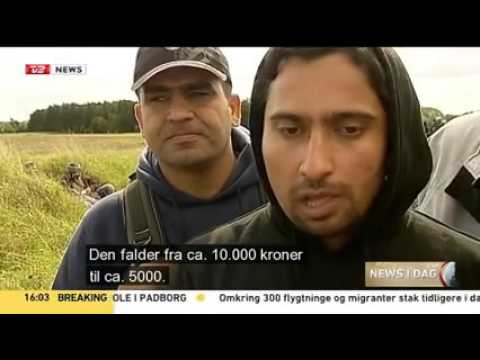
Claire: This is anecdotal, but might provide a clue about why the asylum-seekers are predominantly male:
Lillibellt: This is my point. It’s hard to distinguish between asylum-seekers and migrants (sometimes they are both), but you have to do it. Otherwise, I say it again, you are creating a social time bomb.
Claire: I agree. But as you can see from that video, this will require Europe to coordinate its policies.
Lilibellt: You also have to consider the incentives of the European welfare systems (especially in Austria, Germany, and Sweden). In Austria, everybody, including recognised refugees, who has “no sufficient financial protection by other means” is eligible for the guaranteed minimum income (800 Euros a month for a single man or woman; each child, another 210 Euros.) Recently, the media reported the case of an Afghan family who receives 5,600 Euros a month.
Claire: That “minimum income” in conjunction with Austria not being a deadly war zone is going to continue to attract people — how could it not? Hell, reading that makes me want to move to Austria, I’d quite like a guaranteed minimum income that high! Speaking of economic incentives, this is a natural place to introduce the problem of the economic incentives to human trafficking, which are massive. And busting the traffickers is an incredibly complex transnational problem, about as apt to be successful as the war on drugs. I’ve heard rumors — ones that would obviously be very significant if true — that Russian organized crime has been acting as human traffickers, at least in Greece. Have you seen or heard anything to suggest this is a rumor worth my pursuing?
Lilibellt: No, sorry, I am not even aware of the rumors you mentioned. If, as you said and I agree, this conflict will go on for ten years or longer, there is no way European population will accept peacefully an influx of millions of migrants on their welfare rolls each year, no way. At this point — it is hard to convince the public, but I feel it is still do-able — the only peaceful solution is for Europe to accept only real refugees (women, children, Christians, members of Muslim sects, politically-persecuted people, etc.) and to offer family reunification, in the case of relatives who aren’t persecuted, only after the refugee qualifies for a resident permit and fulfills the economic requirements. Austria took in people after the Yugoslavian war, the Prague spring, and the Hungarian uprising without much complaining (at least, nothing like we are seeing today). I still think that most Europeans are more than willing to help. But if politicians, media outlets, and NGOs keep playing fast and loose with what’s left of Europe’s compassion, I don’t want to imagine what will happen.
Claire: Here’s another situation you don’t want to imagine: There are 4,843,344 Syrian refugees — not economic migrants — in Egypt, Iraq, Jordan, Lebanon, Turkey, and North Africa. A whole generation has been brutalized, is going without any education that would allow them to function in a modern economy, and many are living in squalid camps with absolutely no hope for the future. What happens to children who grow up under these circumstances? Will there even be governments with which the EU can make deals? By the way, did you see that Sebastian Kurz (Austria’s foreign minister) argued for the “Australian model” in dealing with migration?
Lillibellt: I was just translating this interview for you, so it saves me the trouble that you found it too. Yes, really — well — interesting times, when I have to agree with a 29-year old rookie politician instead of the 61-year old “pro” who’s experienced in world politics and head of the leading European nation. I feel uneasy about it. Maybe my take on the refugee crisis is completely wrong after all. I surely hope so.
Claire: The obvious practical objection is that Australia can do this because it’s a single country (and an island). No country in Europe will be willing to commit its sovereign territory to this project, I guarantee it. If you look at this discussion thread, for example where people of different European nationalities are talking about this proposal, you can see immediately what every country’s reaction will be: Use someone else’s island. So even if the case can be made that this is the only way to prevent migrants from drowning, it’s not going to happen.
Lillibellt: That’s a question of leverage. What about a temporary solution where Greece agrees to “rent out” an island for a period of time without losing any territory permanently, and renegotiations are scheduled in advance? Could you see this happening? I honestly don’t see any other way. If anyone has a better idea, be my guest: I’ll listen to it. But it pains me to say, you must stop the refugees and migrants from entering European soil to save them from drowning or putting their lives in danger, and to preserve an EU with open borders. Without free trade and free movement of persons, without open borders, the idea of the EU is soon to be a memory of the past.
Claire: I think if I were Greek, I’d be enraged with what seem to me de facto plans to turn Greece into the EU’s massive refugee camp.
Lillibellt: Yes, if I was Greek I would resent Germany more by the day. I wonder if Merkel is even aware what she has created with the illegal bailout of Greece and now this illegal refugee-welcome party. If the European Union falls apart or slides into an even deeper crisis, she’s to blame.
Claire: What if no one’s to blame? Or no one in Europe, anyway.
Lillibellt: What I do know is that the underlying cause of so many unresolved problems today, not only the refugee crisis, is false compassion. Europe, at least the leader of its most influential country, in concert with EU officials and the media, seems to have decided that compassionate policy, not efficient Realpolitik, is the right way to go. Someone should commend to them the words of Stefan Zweig:
There are two kinds of pity. One, the weak and sentimental kind, which is really no more than the heart’s impatience to be rid as quickly as possible of the painful emotion aroused by the sight of another’s unhappiness … ; and the other, the only kind that counts, the unsentimental but creative kind, which knows what it is about and is determined to hold out, in patience and forbearance, to the very limit of its strength and even beyond.
Claire: I don’t know what an unsentimental but creative policy would look like, in the case of the EU. Sending surveillance equipment to al-Bashir is, I suppose, unsentimental.
Lillibellt: I think the main problem is that the present generation of politicians inherited a fairly good, organised Europe (from Mitterrand, Chirac, and Kohl), with clear objectives and rules (like the Maastricht treaty, which anticipated exactly the problems we are having now). But they lack the competence and gravitas of their predecessors. They have the mentality of bureaucrats, and perhaps it isn’t even their fault, because — as Kafka perfectly described it – bureaucracy is a beast of its own. Merkel even looks like some character out of his books (I know, I know you’re not supposed to make fun of people’s looks, but I couldn’t resist). Why is it that Putin, Orban, or even Erdoğan for that matter — he is not shy about declaring his objectives, you must give him that — can formulate their political goals and philosophies so much more coherently than European politicians, or worse, EU officials? (I am not talking about their actual policies.)
Claire: The beauty of authoritarianism. It’s easy to be clear when you’ve crushed your domestic opposition and you don’t mind alienating the rest of the world.
Lillibellt: Then again, maybe you’re right and the bureaucracy is only a symptom of history repeating itself. Before the First World War, the Habsburg empire was known for having the best civil service administration in the world (like the EU bureaucracy). At the same time, Franz Josef II is said to have had little interest in the military and matters of national defense (like all the EU members, with maybe the exception of the former Eastern bloc countries). And nationalism arose everywhere in the Empire (like everywhere in the EU). You yourself drew comparisons to the Austro-Hungarian Empirein the comment section of our first exchange. Perhaps we have to take another look at nationalism and learn how to make it a force for good (more in the spirit of Dvorak and Liszt) rather than suppressing it. I don’t know.
Claire: I’m not sure how even the healthiest of nationalisms would solve, practically, the problems at hand. That reminds me: Russia. Are you concerned about the alleged links between the FPÖ (the party for which she recently voted) and Putin?
Lilibellt: Yes, I am, or at a minimum I don’t feel too comfortable about it. Admittedly, I haven’t paid much attention to the FPÖ’s connection to Russia or Serbia in the past. If I remember correctly, a former FPÖ party member and now an FPÖ arch-enemy, Ewald Stadler, was an election observer in Ukraine and ruled that everything was okay. The name the most associated with Russia among the FPÖ’s ranks is the party’s vice-leader,Johann Gudenus, who spent time in Russia during his legal studies and is thus fluent in Russian. He was an election observer during the Crimean “independence” referendum, after which the FPÖ supported Russia. Remember you asked my opinion about Hofer’s statement that Kosovo is part of Serbia? Neither the FPÖ nor Hofer released further comment, and there was no follow-up in the press, just that one headline. I still doubt it has much to do with pandering to potential voters, but it does make sense in light of the FPÖ’s engagement with Russia. Overall, I’m not really sure what to make of this apparent alliance between the right parties of Europe (the National Front in France, the AfD in Germany, the FPÖ in Austria) with Russia.
Claire: Is there resentment of Russia in Austria, generally [for worsening the Syrian crisis and generating more refugees], or is Russia seen to be playing a useful role?
Lillibellt: I’m not aware of it. Generally I don’t think, too many people are familiar with the details of the Syrian war and the political players involved.
Claire: What about the US? Is there resentment that the US hasn’t played a more active role or accepted more refugees?
Lillibellt: There is no resentment towards the US because of its lack of activity; far more often Austrians blame America for destabilizing the Middle East in the first place, starting with Bush.
Claire I’m honestly feeling hopeless. I look in every direction and see no rational solution that would be widely accepted in Europe. It’s a classic tragedy of the commons.
…..
Meanwhile in Syria, mere hours after the first food rations in four years were delivered to Daraya, which has been under siege by Assad and starving, Assad began pounding the city with barrel bombs.
A few days ago, I posted the first part of an extended email exchange between me and one of our members, Lilibellt, an Austrian native who now lives in Vienna. Here’s the next part. It gets quite detailed, but even so, we’ve barely begun to discuss the other massive crisis facing Europe. Still, keep Putin in mind as you read this. Peter Dickinson argued in Newsweek yesterday that Europe is still in complete denial about it:
Many inside the EU seem unwilling to admit the 25-year honeymoon period of European peace and prosperity since 1991 is over. They cling to the idea of a return to the old “business as usual” status quo, and appear to believe Russian aggression is only an issue for Moscow’s immediate neighbors.
This policy of obstinate denial is not only morally bankrupt—it also encourages the Kremlin to escalate a hybrid war campaign designed to reverse the results of the Cold War and break up the European Union itself.
We discuss the Putin problem in subsequent email exchanges, which we’ll post soon. I just note it to place what follows in its larger context. Europe has no shortage of problems right now.
Claire: What, specifically, do you think should be done to stem the influx of migrants?
Lilibellt: Four things.
First: Restore lawfulness and secure the Schengen borders. The Schengen-Dublin dilemma shows the chaotic state of Europe at its best. My layman’s understanding of the Dublin III agreement and the Schengen Treaty is that in order to maintain open borders among the Schengen members, migrants and refugees must be processed in the countries they enter first. According to the safe third country rule, people who illegally enter the inland of the Schengen area have to be sent back to the country, within the Schengen territory, whose borders they most recently crossed–
A process for early warning, preparedness and management of asylum crises serving to prevent a deterioration in, or the collapse of, asylum systems, with EASO playing a key role using its powers under Regulation (EU) No 439/2010, should be established in order to ensure robust cooperation within the framework of this Regulation and to develop mutual trust among Member States with respect to asylum policy.
What do the words “solidarity” and “trust” mean in concrete, legal terms? I don’t know and doubt anyone does. But according to (EU) No 439/2010,
For Member States which are faced with specific and disproportionate pressures on their asylum and reception systems, due in particular to their geographical or demographic situation, the Support Office should support the development of solidarity within the Union to promote a better relocation of beneficiaries of international protection between Member States, while ensuring that asylum and reception systems are not abused. [My emphasis]
Austria is definitely a “member state faced with specific and disproportionate pressures on its asylum and reception systems, due in particular to its geographical or demographic situation,” right? Problem is, there are many ways that clause could be interpreted. It could support Austria’s demand that Greece and Italy better control their borders; but it could just as easily support a Greek or an Italian demand that Austria accept more asylum-seekers and process them on Austrian territory. After all, Greece and Italy too have been “faced with specific and disproportionate pressures.”
But before we look at the legal details, let’s focus a bit on the history of the crisis and the region’s geography. It’s important to visualize how complex it is to secure every border by which someone could enter Europe, and how much cooperation it would require among countries that still have no established common mechanism for border control–
Lilibellt: –it’s easy to see that European countries with territory bordering non-Schengen countries were at a great disadvantage in the summer of 2015, when the influx of refugees and migrants increased dramatically. Hundreds of people killed in the Mediterranean. Thousands upon thousands of refugees in Lampedusa and Idomeni, and no end in sight. As far as I know, the EU made no concerted effort to help countries like Italy, Greece, or Hungary deal with this huge number of asylum-seekers. Instead, it turned a blind eye the way Italy and Greece were openly violating the Dublin agreement by not registering asylum-seekers and just letting them move on.
Hungary began building a border fence, first along the border with Serbia, then along the borders of Croatia, Slovenia, and Romania. Hungary was ferociously criticized for its policies both by the German and the Austrian chancellors. The Austrian chancellor, Werner Faymann, likened Hungarian Prime Minister Viktor Orban’s refugee policies to Nazi deportations. Maybe I’m not savvy enough, but to me it looked as if unlike Italy and Greece, Hungary had secured its borders — and in doing so, had complied with its duty as the external frontier of the Schengen Area.
Another major turning point was German Chancellor Angela Merkel’s press conference in the late summer of 2015, in which she announced Germany’s unilateral suspension of Dublin III for Syrian refugees, which meant, defacto, that all refugees and all migrants could come to Germany directly without threat of being deported to a safe third country (such as Hungary or Greece). But if there’s no registration at the Schengen borders, how do you know who’s a Syrian refugee and who’s not until they’re in Germany? Her message, “We can do it,” was heard loud and clear around the world, especially today, with social media and the Internet. So Syrian refugees, and refugees from other countries who were pretending to be Syrians, and migrants who had conveniently lost their papers — they all set off for Germany. By now I’ve lost track of which countries have suspended Dublin III and Schengen.
This is what I meant when I quoted Weber. An ethics of responsibility would demand from politicians non-ambiguous formulations, hard distinctions, and the definition of a clear, feasible objective with all the hard measures and heartbreaking pictures that come with it. Ethics of opinion, on the other hand, are laws and treaties as vague as Dublin III, or Merkel’s announcements that “We can do it,” or her references to the inviolability of human dignity (Article 1 Par. 1 of the German Basic Law – which now applies to the whole world, in effect), or, “There is no legal limit to the number of asylum seekers in Germany.” That may be correct according to the Geneva Convention, but it is certainly not feasible in reality. Her speeches don’t give people any specific answers, but they give them the good feeling of being on the right side of history (this time around). All the hard measures will be taken and the heartbreaking pictures will surface anyway, and maybe more so, but who cares, we had the right intentions!
Austria, in any case, reinstated border controls in January–
Claire: –how well did that work? What was the daily influx before that, and what was it after that?
Lilibellt: As far as I can tell, along with other measures, it improved the situation. The trend peaked at 12,000 asylum requests per month in October 2015, and now it’s reversing. Last April there were “only” 4,000 asylum requests. But it could also be seasonal, we can’t draw conclusions until the end of summer.
Claire: What does it take, in terms of manpower and resources, physically to patrol all of Austria’s borders?
Lilibellt: Hard to say, because I’m no expert. It seems to me that the mountainous provinces of Vorarlberg, Tyrol, and Carinthia have natural barriers against the south (Italy and Slovenia) and the west (Switzerland), and aren’t too hard to secure save for the mountain passes. For the time being, border controls in some places, for example at the Brenner Pass between Tyrol and Italy, have been suspended. But security measures are in place if needed. There’s a realistic possibility that Italy will hold up its end of a recent agreement to prevent illegal aliens from crossing the border to Austria, if only out of self-interest. If Austria reinstates border controls at the Brenner Pass, it would hurt Italian tourism. In the east, Hungary has already secured its borders, so I’m not sure if Austria needs to take any further measures. Until now, there seemingly hasn’t been a large number of refugees coming from the north. Slovakia, like Hungary, is a member of the Visegrad Group, which opposes refugee quotas for Europe.
That leaves a non-mountainous area of 90 miles on the southern border, with Slovenia. The government has built a fence there. In the winter there were almost no asylum requests. All in all, I think 90 miles is manageable, even for a little country like Austria. But as we discuss later on, I don’t think border walls or fences are the best way to deter migrants. Far more important is the restriction of benefits. If you have the right incentives, you can finally deal only with the real refugees.
Claire: Given that steps have been taken to secure the border, and given that the flow of migrants fell sharply as a result, why were you so unhappy with the government’s performance? Is your chief complaint now a matter of the ease with which criminals can escape deportation? Or was your vote intended to send, in a sense, a vote of no-confidence to Merkel and the rest of the EU, a warning that they need to get it together?
Lilibellt: Because like many others, I suspected that these measures were primarily taken to avoid an FPÖ president. The numbers of asylum requests are down, but like I said before, really conclusive data won’t be available until the end of summer. If you look at the graph, you see that the numbers of asylum requests this spring compared to last year are the same, the decrease is only in comparison to previous (warmer) months. The unusual numbers in May and June may just be because spring was unusually cold this year.
There are no longer crowds of refugees waiting at the stations for trains to Germany, or waiting, and even sleeping, in front of the interior ministry, or the social services, or — for example — in front of the house I live in. The distribution of the refugees has definitely improved.
But between the two rounds of the elections, Chancellor Faymann resigned and a new government was sworn in. And just yesterday, the new chancellor, Christian Kern, backtracked on proposals to limit asylum requests. The new state secretary for immigration, Muna Duzdar, who’s of Palestinian origin, is a strong open-border supporter. Exactly what I expected if [Green Party candidate] Alexander Van der Bellen won the presidential contest.
I voted for [the FPÖ candidate] Norbert Hofer because I wanted to avoid a situation like this, where the government continues ignoring half the people after the election. On top of that, large parts of the media, the president, and the government keep referring to FPÖ voters as resentful, unsuccessful, poorly educated, misinformed xenophobes in need of their guidance and understanding. A highly dangerous mix that will fuel resentment and radicalization on the other side even more. I really worry. The first refugee camp on Austrian soil — uninhabited, they were going to arrive soon! — has already been burnt down. Until now, arson like this only happened in Germany.
Let me repeat that I would rather see stronger measures taken to send rejected asylum-seekers back home, and separate refugees from migrants in a faster, less bureaucratic way, than to limit to asylum requests. In short, it should be about the real refugees and not (yet) about the limitation of access for real refugees. But the concern I mentioned in the first part of our interview — that last summer’s failure to distinguish between migrants and refugees would harm the real refugees — has already come to pass. Germany is examining the possibility of declaring an official limit to the number of asylum applications it will process this year. Austria already declared one. Well done, EU and Frau Merkel.
And just as Dublin and Schengen are incoherent, the same is true of the European legal system. So there’s an appeal process for asylum-seekers not only at a national level, but the European one; there are European Court rulings that refugees can’t be sent back to Greece and Hungary, because they aren’t considered safe third countries. Expediting the selection process would surely be in violation of one of the many agreements and treaties in place. So it’s generally “easier” – especially in light of Germany examining the same possibility right now, perhaps confronting the same dilemma – for Austria to limit the number of asylum requests. Total madness.
Claire: What were the economic effects of sealing the borders—was commerce affected, trucking, imports and exports? How did businesses that rely on trade with the rest of Europe respond?
Lilibellt: Really sorry, but I don’t have enough insight to answer that question. Anyway, Austria will likely lift the suspension under the new SPÖ Chancellor Kern — and Greece and Italy still haven’t secured their borders.
Claire: Let’s remind people here that these are maritime borders, and perhaps explain what happened with Operation Mare Nostrum. In October 2014, Italy ended its search and rescue operations after critics in Italy and Europe claimed that the rescue mission was just creating incentives for more migrants to attempt the sea crossing. The Italian government had been spending nine million Euros a month on it. Italy asked the rest of the EU for funds to support the operation; it refused. But cancelling the operation didn’t result in a decreased rate of crossing. Within a month, a thousand people had died in shipwrecks.
… is arguably more for show than substance – a microcosm of everything that is hampering a pan-European response to the current crisis. …
Frontex actually has little power and struggles to operate in the straitjacket imposed by the collective failure of member states and Brussels to fully commit and cooperate with it – despite the current crisis. …
… Our investigation has also uncovered official warnings about the way the agency oversees the return of illegal migrants.
And even its intelligence-gathering role is hampered by a lack of member states’ action.
Frontex risk analysis during the past three years correctly predicted a surge of refugee numbers streaming through the central Mediterranean, Greece and Hungary.
The trouble is Europe did not act on its findings.
The consequences of these EU-wide failures has been to create an environment in which thousands of people have drowned at sea and where smugglers have made fortunes from refugees fleeing war.
Greece is an archipelago, and I truly think it never occurred to people before this started happening that so many people would risk their lives to cross the Mediterranean in rubber boats: It was assumed this was a reasonably impenetrable natural barrier. I also suspect that people keep thinking about this without thinking about the context in the MENA region. It used to be possible, for example, to make (extremely dirty) deals with Qaddafi: “You keep anyone from escaping, we’ll pretend we don’t know how you make that happen, and we’ll invest in your oil.” And Syria of course used to be a Baathist dictatorship with a very strong state; now it’s a failed state and a refugee factory with no authority strong enough to control its own borders.
There’s no easy solution to this that doesn’t involve killing people who are trying to escape these places. In a way, the collective non-decision to let them drown is a passive-aggressive way of deciding, “We will protect our borders with force. If you try, you will die.” No one has to shoot them, but not rescuing them amounts to the same thing—
Lilibellt: —The EU didn’t help. No question. But since everybody wanted to get to Germany, Austria, and Sweden anyway, Italy and Greece waved through most of the arriving migrants without processing them.
Lilibellt: That’s true, but the refugees don’t apply for asylum in Greece (in contrast with Italy):
Lilibellt: –Austria wasn’t any better, the state-run railway company transported thousands of migrants to the German border. You can’t overlook the irony here, the man who was in charge of the company back then is now our new, sworn-in chancellor – actually a human trafficker himself. If you did the same thing with your private vehicle, you would end up in jail. Craziness all around, and not many journalists who seem to care.
But let me continue to my second point: Don’t process refugees and migrants on national territory. Create an offshore detention facility protected by the military, e.g. on a Greek island or in North Africa, with clear preferential treatment to refugees.
Claire: Do you know if any Greek island or African country has expressed a willingness to do this? Greece is already de facto a refugee holding pen, and I suspect wouldn’t agree to this being formalized.
Lilibeltt: If I remember correctly, Greece has and will again very soon receive bailout payments. Am I being too simplistic, or do I see some leverage here? (And there are islands without inhabitants.) I concede that Greece is having a hard time right now, but it is partly self-inflicted, and they can’t accept refugees refusing to be transported to other places. Hard decisions will have to be made and the pictures won’t be pretty.
Claire: It’s not pretty, no, especially because everyone’s response is, “Keep them somewhere else.” And since politicians are responsible to their national electorates, rather than a larger “Europe” (no matter how hard the EU pretends it has authority), everyone tends to blame their immediate neighbors for the problem rather than looking at the impossible problem — the conflicts that are prompting people to flee.
Austria’s not a superpower, it doesn’t have an “Eritrean policy.” Turks are asking, “Why the hell are we responsible for all of this? We’re not even part of the EU, we’ve taken more refugees and spent more money than any other EU country, and now you don’t even want to let our citizens travel to Europe? How insulting can you possibly be!” — it’s all understandable, at the national level.
Lilibeltt: Third point: Urgently negotiate readmission agreements with Afghanistan, Morocco, Tunisia, Pakistan, Somalia, Chechnya. Doing this is mentioned specifically in European treaties, but the European Commission can’t be bothered; they’re too busy calculating the penalty payments for member states that don’t accept their refugee-quotas. If the EU is unwilling to do it, Austria should conclude bilateral treaties.
Claire: What’s wrong with the readmission agreements as they’re now written, and what would the goal of these negotiations be? Is there evidence that the EC can’t be bothered, or might it be that they’re trying, but it’s taking a long time and they’re not getting much cooperation from the governments in question? I’d think cooperation would be good with Morocco and Tunisia. Neither country is apt to be producing many legitimate refugees, so in principle there should be very few, or no, unskilled job-seekers coming from there to Europe. I don’t know whether the Afghan state has enough control to negotiate treaties expeditiously. Wouldn’t any agreement with Chechnya have to be negotiated with Russia? I don’t know how that would work–
Lilibeltt: –I was a bit sarcastic there. Yes, they are negotiating right now, but I sense a lack of urgency. What I should have written: Urgently finalize negotiations with those countries. I stand by the last sentence: If the EU doesn’t succeed in doing so in the near future, we should begin bilateral negotiations. Afghanistan and some others will be difficult, therefore there have to be detention facilities, not only for migrants of certain nationalities, but also for migrants who have conveniently lost their papers.
Last point: There should be massive financial and military support for refugee camps in the region.
Claire: Absolutely agree with you about that. Do you think it’s necessary for Austria to become more involved in settling the conflicts that are producing so many of these refugees? I don’t think the influx from places such as Syria and Libya is apt to stop until the civil wars stop. The push factor is just too high.
Lilibeltt: Yes, correct. As much as I wish that America would be more involved, I also agree with people on Ricochet who think it’s time for Europe to take on some responsibility. You can’t always leave the dirty work to Americans and then condemn them for waging war or having self-interested motives. “Oil, you know!” “Austria is politically neutral like Switzerland, so conveniently, we are off the hook.” Those are the opinions of most of my fellow Austrians.
Claire: But you do support both the EU and the letter and spirit of the Geneva Convention, it sounds. Is this a common view among people who voted FPÖ? You sure wouldn’t know it from the press, if so.
Lilibeltt: I say: EU: Jein (Yes and No) – another time. The EU directives on asylum go beyond the Geneva Convention. (I support the Geneva Convention within its “natural” limits: For example, a country can’t grant asylum to as many people as it has inhabitants; or at least, I wouldn’t support that, it must be feasible enough that a democratic majority will be comfortable with it. But this is common sense, isn’t it?) The FPÖ says, EU: Yes (with the emphasis on Union of Nations, not a United States of Europe – paraphrased from their party program).
Claire: The vagueness of Dublin III is a recipe for conflict. Every country blames the other, no one to has sufficient legitimacy to take responsibility, and no one, therefore, takes responsibility — leading each member state to an even greater lack of “solidarity, trust, and smooth functioning” with the other.
And for everyone who will automatically say, “The problem is the EU, get rid of it,” I have to ask: Then what? Re-hire the same bureaucrats to negotiate a new treaty that at best will say exactly what EU No. 439/2010 does? Someone will have to negotiate these treaties if there’s to be any cooperation — and they will require an EU-like structure to implement.
Lilibeltt: The downfall of the EU was the Greek bailout — also under Merkel — in violation of the Maastricht Treaty. A much more complex problem than it looked on the surface, much like the refugee crises, but that’s the problem with this kind of lawlessness, it comes back to bite you. Losing trust is so much easier than gaining trust. I don’t see the EU recovering from this, and that’s the most scary part: What will a Europe without the EU look like?
Claire: My instinct, based on the reality of power politics, is that the US will ultimately either lead these negotiations and dictate a solution to this problem (to a reasonable approximation of sanity, at least) or cede Europe to Russia. But we’ll pick up that point from here next time–
Lilibeltt: –what I’m sensing and guessing is that the people (not the politicians) of middle Europe, at least, distrust America more than Russia. The reasons for that are simple: The hard left (anti-capitalism) and the hard right (latent and open anti-Semitism, nationalism) are indistinguishable in their anti-Americanism. The political center to a large extent thinks America is the reason for all of this turmoil in the first place, either because of the Iraq War (among those who lean left), or because of Obama’s naivete (among those who lean right).
Claire: On top of that, if the European state that would naturally dominate decision-making, by virtue of wealth and power, tries to dominate decisions like these, the rest of Europe goes nuts, because Germany’s history of trying to do that has left … bad memories, shall we say. Neither France nor Germany can impose their will on the situation because the whole point of the EU is to contain that rivalry. And Britain is useless; they can’t even decide if they want to be part of Europe. So effectively, the smaller states are the victims of the chains Germany and France have placed on themselves.
This is where our conversation ends, for now. To be continued.
……………………………………….
Thank you so much for the contributions that have allowed me to focus my attention on stories like this. I’d of course be hugely grateful for support toward defraying the costs of travelling to the countries affected by this (starting with Austria), seeing what’s happening with my own eyes, and then writing about what I see:
 Global financial panic, Sterling collapsing, and Scotland — possibly Northern Ireland, too — apt to break away. Quite a day’s work.



 This is the third and final part of the extended email exchange between me and one of our members, Lilibellt, an Austrian native who now lives in Vienna. For those of you who missed it,