Saturday, April 8, 2017

Abu Ivanka al-Amreeki and the Bureau des Étrangers

 
If you have a few minutes, read this essay by Peter Harling, The Syrian Trauma. He wrote it in September 2016, but I only discovered it about two weeks ago. I haven’t been able to stop thinking about it, though.
“Every now and then,” he wrote,
the conflict in Syria produces an iconic image of horror and suffering, which many brandish as an undisputable truth that will finally shake the world into “doing something.” Others break down at the sight of such images, or instinctively avert their senses. Mass killings and disappearances, industrial-scale torture and sexual abuse, gruesome staged executions, starvation tactics, the continued use of chemical weapons, napalm, cluster and barrel bombs, not to forget the torments of desperate emigration – all have spawned morbid emblems of their own.
“Arguably, all conflicts are traumatic,” he continues,
… Syria seems nonetheless to bring in something different, hard to pin down — an elusive truth that is precisely what we should not fail to understand. Indeed there are many layers to the Syrian trauma. First, Syrian culture, in normal times, is remarkably civil. The Syrian dialect of Arabic is ravishingly polite. Education is a source of national pride. Unlike many other parts of the Arab world, urbane mores permeated the countryside more than a rural ethos reshaped the city. Communal coexistence, edgy on occasions, was nevertheless a profession of faith.” 
It occurred to me, as I kept reading, that the Syrian civil war is an event, like the Holocaust, that showed us something new about our innate capacity for depravity. If the Holocaust made clear that humans had the ability to unite the task of murder with the age of industrial efficiency, Syria showed us that we could unite murder on a mass scale with instant, global communication — and remain indifferent, bored, even angry with the victims of what has surely been the most widely-viewed crime of its sort in human history.
Atrocity after atrocity has been documented, filmed, frantically uploaded, broadcast, in real time, to an indifferent world. It is hardly the world’s first terrible war, of course. But it’s the first conflict of this magnitude to take place in the age of the Internet and the cell phone. It’s the first time the whole world has been able to see, in so much detail, the faces of the grieving and the dead, to hear the voices of victims begging for help. Anyone with a phone can even call Syrians themselves to speak to them directly — on Skype, no less, for free. And the world, having seen this, replied, “So what.” The world listened as half a million Kitty Genoveses screamed for help. It shrugged. 
Thus, wrote Harling,
… a fifth and related source of trauma for Syrians … the horrifying spectacle of an outside world watching on as their country is pointlessly and endlessly tortured. They have learned the hard way how shallow and callous our media and politics can be. People who remember every sorrow in every detail must contend at best with generalized amnesia, at worst with conventional wisdom dismissing their life experience. Their misery is met with fatigue; their flight to safety with hysteria.
On Tuesday, videos and photographs displaying the aftermath of a chemical weapons attack on Khan Sheikhoun, south of Idlib, emerged. Again, anyone with a cellphone could see what it’s like to experience this:

I expected the world to meet this with the same indifference as it had all the previous attacks. And for all the reasons that don’t bear repeating, I certainly didn’t expect President Trump to do anything about it. But yesterday the news broke in the middle of the night (in Paris, anyway) that the United States had launched 59 Tomahawk missiles at Shayrat Airfield, targeting “aircraft, hardened aircraft shelters, petroleum and logistical storage, ammunition supply bunkers, air defense systems, and radars.” That’s the airfield from which the planes that dropped chemical weapons on Syrian civilians — and then bombed the hospitals treating the victims — took off.
Usually, when news of this magnitude breaks I sit glued before my screen, trying to figure out what’s going on. But I couldn’t this time: I saw the headline, then had to rush out the door. I’d been awake for hours already, assembling my documents and preparing to spend a long and stressful day at 17-19 rue Truffaut. 

17-19 rue Truffaut
Like all foreigners who live in France, I need permission to be here. My case falls under an unusual bureaucratic category called “exceptional family circumstances.” But as you can imagine, the Bureau des Étrangers at 17-19 rue Truffaut is overwhelmed by petitions from desperate people with good reasons to want to be in France, ranging from “exceptional family circumstances” to “I will be killed immediately if I go back” to “That’s not a good enough reason, you have 48 hours to leave the country.”
Given the number of applicants at the Bureau des Étrangers on any given day, and given the general principles under which the French bureaucracy labors, these visits are stressful. 
I go with everything I can imagine a French bureaucrat wanting to see: my birth certificate, my grade school report cards, my college transcripts and diplomas, my medical records, my father’s medical records, my mother’s last will and testament, my certificate of health insurance, tax records, rental contract, phone bills, electricity bills, my grandfather’s service medals, every book and every article I’ve ever written, half a dozen passport-sized photographs, notarized translations, duplicate copies, triplicate copies — I go with so much bureaucracy-pleasing paperwork that I have to put it in a suitcase. I arrive at dawn, demurely dressed, and wait on line in the cold with all the other stressed, demurely-dressed people until they open (promptly at 9:00 a.m.) – and then we wait on line for hours more.
As we wait together, we naturally bond over our anxiety about what awaits us inside that forbidding building. We’re all desperately eager to appease and please the bureaucracy, but none of us really understand what it wants — no one actually knows, in fact, including the people who work there. We all fear angering it by accident. We’ve all heard stories about things that can happen — to a cousin, an uncle, to someone who worked as a dishwasher in a restaurant in the 9th — and none of us know what to make of these stories or whether it could happen to us. 
The first time I went there, it suddenly occurred to me to wonder if this could be the very place my grandparents stood on line, in 1941. I had heard the story of “standing in line” from them, but I don’t think they ever said where, exactly. My grandfather had been promised French citizenship for his service in the Foreign Legion. He’d fought in the Battle of France, on the Belgian border. He was one of only 250 survivors of his 1,250-man regiment. But then France fell, and the only thing they could hope for was an exit visa. I wondered if they’d stood on that line, just like me. But with one very big difference, of course. If the bureaucrats looked at my papers and said, “No,” I’d be deported. Had the bureaucrats inside looked at my grandparents papers and said “No,” they would have been sent to the death camps.
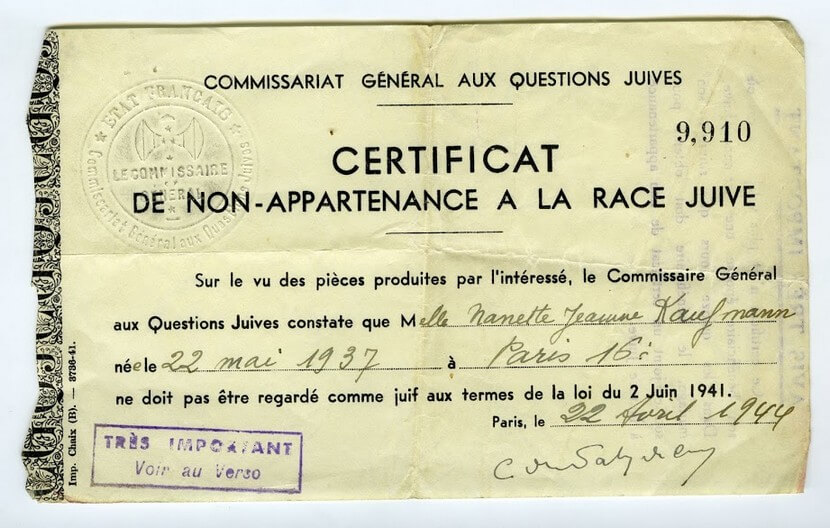
An official certificate of “Non-belonging to the Jewish race.”
I don’t know whether my grandparents fully understood, at that time, what would happen to them if they were sent to the camps. I asked my father whether they knew, but he doesn’t know, either. There were certainly many rumors about by 1941. But people refused to believe what they were hearing. Perhaps my grandparents didn’t allow themselves to think of that while they were waiting. You can’t think like that if you’re trying to persuade an overworked bureaucrat that all of your paperwork is in the right order and makes perfect sense. 
Yesterday morning, everyone’s eyes, like mine, were glued to their cellphones. We were all trying to figure out what had just happened in Syria and what it meant. We were all a bit scared to talk about it with each other. None of us knew for sure where the other people around us came from, after all. Obviously, I didn’t want to end up in a shoving match with a Russian — in front of the cops and multiple surveillance cameras — right before trying to make my case to the officials that I’m a harmless, law-abiding, middle-aged woman who wouldn’t even inconvenience the French state, no less get in a public brawl right in front of the Préfecture de Police. It was strange: everyone was reading the news on their screens, furtively glancing at each other, and then tentatively, whispering, Qu’en pensez-vous?”
What do you think?
It was definitely not the right time or place for me to say — as I usually would — “Hi! I’m an American journalist, and I’d like to know where you’re from and your reaction to President Trump’s decision to launch cruise missiles at a Syrian air base.” It wasn’t even the right time for me to guess where people were from. Wherever you’re from, when you’re on that line, you speak French and you act as assimilated as you know how to act. So I can only say what I saw and heard; I have to guess what it meant.
There was a Frenchman near the line, or at least his accent was Parisian. I think he worked inside and had come out to smoke. He was about forty. He glanced at the screen of my phone, which — like his, like everyone’s — showed the words, “Frappes en Syrie : la Russie dénonce « une agression », les alliés de Washington applaudissent.” We made a bit of small talk. Vous êtes américaine?” he said. (My accent gave it away.) I said yes. He’d been to New York once, he’d heard California was beautiful. Did I like France? We both looked at my phone. I said, Qu’en pensez-vous?”
He looked as if he wasn’t sure. Then he said, Avez-vous déjà été en Normandie?”
I said that I had.
C’est impressionnant, Je pense à ces gosses américains. Ils ont traversé un océan, sont venus dans un pays dont ils n’ont jamais entendu parler, pour faire cela pour nous … “
Believe me, this is not usually the first thing people here say when I say that I’m American. I can’t say for sure why he said it or what he was thinking. 
There were a handful of men next to us from Mali, I’d guess, or from somewhere in Francophone Africa. They were perhaps in their thirties. Qu’en pensez-vous? I said to them
One said, tentatively, “Je pense que … j’espère que cela peut être bon, si ça fait bouger des choses … Si cela peux changer quelque chose … “
Another interrupted, “Non! Je ne suis pas d’accord! Ils ne sont même pas allés à l’ONU. Chaque fois que l’Amérique s’implique, elle empire!” He realized he’d raised his voice more than he intended, and returned to a hushed tone. “Mais c’est trop tard, ils auraient dû le faire depuis longtemps, les Américains. Les Syriens, ils ont trop souffert.”
Assad, il est un fils meurtrier [redacted],” said the first. A statement, not an argument. Everyone near us nodded quietly. No exceptions on that.
A woman from, I’d guess, somewhere in north Africa, there with her two kids, both runny-nosed, asked me, “Pourquoi Donald Trump a-t-il changé son avis? Il n’y a que 48 heures, il était quelqu’un totalement différent.”
Usually, I can handle any and all questions about American politics and how America works. But I was as stumped as my interlocutor. I told her I honestly hadn’t the first clue. That I was completely surprised. That it was the last thing I thought he’d do. Mais je suis très heureuse que nous l’avons fait. Enfin."
Everyone fell quiet.
We were all still waiting on line when the jokes about Abu Ivanka al-Amreeki hit the Internet. They made the Malians laugh, although no one — literally no one but me — got the joke about Kushner of Arabia.
I hope everything went okay for everyone else on that line. I hope none of them were deported.

Tuesday, April 4, 2017

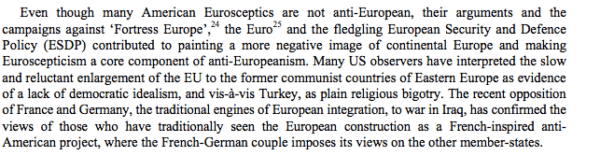
Anti-Americanism and Anti-Europeanism

In 2004, I reviewed a book called Anti-Americanism, written by the French philosopher and essayist Jean-François Revel. Revel was at the time eighty years old; he was to die two years later. A socialist in his youth, he later became a prominent European proponent of classical liberalism and free market economics. You can read the essay that he later expanded into the book here.
Although I found his book, ultimately, insubstantial, I appreciated his effort to show that the kind of anti-Americanism then fashionable in Europe was irrational and internally incoherent: 
The book’s chief mode of argument is to expose the inherent contradictions in their position: Americans, he notes, are pilloried simultaneously for their puritanism and their materialism, for their isolationism and for their imperialism, for their reluctance to dispense economic aid and for dispensing that very aid—this last generally interpreted as a sinister effort to control the destinies and dignity of the beneficiaries. 
Revel had little trouble convincing me that Europeans who were obsessed with American failings were often hysterical, inconsistent, or ungrateful. But why were these view so commonly found in Europe? Ultimately, I wasn’t persuaded by his explanation:
Revel’s answer: To affirm the anti-American position is to attack liberalism itself; modern anti-Americanism, he holds, is the socially acceptable avatar of illiberal belief systems—Marxist ones, chiefly—discredited by history. Anti-globalists, in his view, are synonymous with the anti-Americans.
Now, remember that I wrote that in 2004, when no one imagined that in 2016, an American president would come to power on an anti-globalist platform. Anti-globalism was at the time the purview of the protesters who rioted, vandalized, and terrorized Seattle during the 1999 World Trade Organization ministerial conference.
l thought Revel spent too much time picking off the low-hanging fruit, intellectually speaking:
… not all anti-globalists are unreconstructed cold warriors, and not all criticism of the modern economic order is crude. If it was Revel’s aim to dismantle their arguments conclusively, he does not succeed. To do so, he would have had to engage with the anti-globalists’ best arguments rather than their worst ones. The most sophisticated critics of the American-led economic order contend, for example, that the advantages of free trade posited by Adam Smith can accrue only in the context of other liberal freedoms, most notably free movement of labor. The decreasing regulation of trade has in the past half-century been accompanied by increasing regulation of migration. In this context, critics charge, the assumption that all nations will by means of the Invisible Hand take their rightful and prosperous place among the community of nations fails to obtain. It is the lack of freedom—the lack of liberalism’s benefits—suffered by those structurally excluded by the GATT and various multilateral agreements on investment to which these critics address themselves, not always absurdly. Anti-globalists charge that these agreements effectively remove power from accountable bodies such as parliaments and repose it in unaccountable corporations, a criticism that is ideologically compatible with classical liberalism. It may not be correct, but it is not anti-liberal.
Still, I thought Revel did two important things. First, he demonstrated with ample evidence that this delusional species of anti-Americanism truly was widespread in Europe:
Note the reception of 9/11: The Big Lie, a book by the French journalist Thierry Meyssan, who argues that no airplane crashed into the Pentagon on September 11. He proposes that the American secret services and its military-industrial complex invented the event to prime their gullible, sheep-like countrymen for a war of imperial conquest against Afghanistan and Iraq. The book was a bestseller in France.
Second, he argued that since this kind of anti-Americanism had no evidentiary basis, it could neither be rebutted nor taken at face value: It had to mean something other than what it purported to mean. But what?
Anti-Americanism, Revel concludes, is a cultist system of faith rather than a set of rational beliefs. It is thus impervious to revision upon confrontation with logic, evidence, gestures of goodwill, public relations campaigns, or attempts on the part of the American secretary of state to be a better, more sensitive listener. The American Left’s contention that it is the current administration’s foreign policy that has made the United States an object of hatred worldwide is delusory. Revel is dismissive of their program to understand the world’s antipathy toward the United States by means of pained introspection and to correct it with improved behavior: Nothing Americans might do, short of disappearing politely en masse, will help.
Fifteen years later, I’m not sure how well his book, or my reaction to it, have held up. He missed a lot and so did I.
One of the things we both missed is that a parallel vein of anti-Europeanism runs through American political and cultural life.
I’ve been thinking of this recently as I’ve read comments about Europe on various social media that might have been written Russian bots programmed to alienate the United States from its Atlantic allies, but were probably written by real Americans who feel about Europe pretty much the way Thierry Meyssan felt about the United States — and with about as much basis in logic.
So when recently I happened upon this paper by the economist Patrick Chamorel about anti-Europeanism and Euroscepticism in the United States, I read it with interest. It was published in 2004, shortly after Revel’s book. Chamorel was then at the Hoover Institution:
The paper documents and tries to explain the rise of anti-European and Eurosceptical sentiment in the United States since the end of the Cold War. Contrary to anti-Europeanism, which has always permeated American culture and underpinned American exceptionalism, Euroscepticism is more confined to political and business elites and targets the process, main policies and identity of the European Union. Although usually conservative, Anti-Europeans and Eurosceptics do not necessarily overlap: anti-Europeans are Eurosceptical but the reverse is not necessarily true. However, Anti-Europeanism and Euroscepticism have become entrenched beliefs among many conservatives.
Europe’s positive image since WWII and the wide support for European unification among American elites, have been replaced by competing views: for example, neo-conservatives believe Europe to be in economic, demographic and cultural decline that the EU only precipitates. Others see a unifying Europe as a rising power which will become more a rival than an ally for the US. Since the early 1990s and increasingly until the war in Iraq, conservative commentators have attacked the style and content of European foreign policy, especially with regard to the Middle-East, Europe’s weak defence budgets, its lack of resolve against terrorism, its welfare state and highly regulated economy, its left-leaning political culture, its growing anti-Americanism and anti-Semitism. The centralizing, elitist and regulatory aspects of the EU have also been denounced to justify Euroscepticism.
It’s only about a dozen pages, so you can read the whole thing quickly, but I’ll just pull out a few passages that struck me. Here, for example, he suggests that some Americans have come to see Europe as a kind of oversized Blue State:
As you keep reading, you may find yourself asking whether the criticisms of Europe that were widely heard in 2004 are still germaine. Was Europe — France in particular — right about Iraq? The current American president certainly thinks so; so obviously, the beliefs for which the French were pilloried in the runup to the Iraq war are now widely accepted among Americans.
The following passage is especially interesting, because it shows exactly the kind of contradiction that Revel pointed out when he wrote about European anti-Americanism:
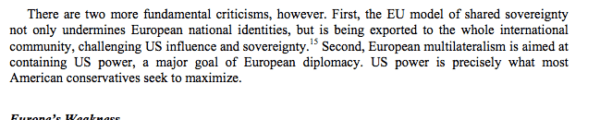
He expands on this point, but the key, to me, is that the EU is criticized for being too weak and for being a challenge to US power. Like the accusation that the US is both too imperialistic and too isolationist, the claim is so internally inconsistent that we have to assume it’s not an argument but an article of faith. But faith in what?
It’s also interesting to see what American conservatives found objectionable about Europe in 2004 and how different their criticisms were from their criticisms today — even though the underlying sentiment seems unchanged:
I now see some American conservatives criticizing France for not being as eager as they think the French should be to put a Le Pen in power. (France just can’t win with that crowd.)
Then there’s this argument, which is remarkably different in emphasis from criticism nowadays, isn’t it?
Like Revel, Chamorel suggests that these arguments are too contradictory and illogical to be taken at face value.
What, then, really underlies anti-Europeanism? He entertains the following hypotheses:
  1. It’s a backlash against anti-Americanism in Europe.
  2. It’s a response to the end of the Cold War. The United States promoted European integration as a response to the Soviet threat; now that the threat has abated, the EU has come to be viewed as a strategic competitor, rather than an ally.
  3. The United States favors globalization, whereas Europe uses the EU as a shield against globalization.
  4. Americans think of themselves as manly men from Mars and Europeans as sissies from Venus.
  5. There’s no divide between the US and Europe; the divide is an internal one between America’s coastal elites and the culturally conservative “America First” hinterland. (Interesting that he uses the phrase “America First” in 2004.)
  6. It’s a neo-conservative reaction to the strength of the left and far-left in Europe, which have paradoxically become more critical of the United States in the wake of the collapse of the Soviet Union.
None of these hypotheses, he acknowledges, quite account for the phenomenon. (And two of them certainly couldn’t account for the phenomenon now: The Russians are back; and Americans themselves have elected a president who promises to unravel the “false song” of globalization.)
What, if anything, strikes you as notable about Revel’s claims or Chamorel’s arguments? How well do you think these essays have held up to the test of time? What do you think really underscores anti-Americanism in Europe or anti-Europeanism in America?

Friday, March 31, 2017

NAQ: The French Elections

There's so much fast-breaking domestic news to follow (Flynn? Immunity?) and so many complex, major crises abroad, that you may be entirely forgiven for paying no attention whatsoever to the upcoming French elections. But if this were a more placid moment in history, you'd probably be hearing a lot more about France’s weird presidential campaign, actually one of the weirdest in French history.
So I've compiled this NAQ -- a list of never-asked questions -- to answer some of the questions you would have asked if this were a normal news year in which a French election could actually get anyone's attention for more than a second.
Q. How does France work?
A. The president -- who serves a five-year term -- is directly elected by French citizens. (The term used to be seven years; it was reduced to five in 2002). The French Parliament is bicameral. The National Assembly has 577 members, who are elected directly by the citizens of their constituencies and serve a five-year term. The Senate has 348 members, who are elected for six years by the electoral college.
Q. Who's in the electoral college?
A. One elected representative from each of metropolitan France's 98 departments, plus eight from France's other dependencies and twelve from the Assembly of French Citizens Abroad. 
Q. So when will the presidential elections be held?
A. The first round will take place on April 22, and the second round on May 6. In theory, if any candidate wins an absolute majority (50 percent of the vote plus at least one more vote) in the first round, he or she is immediately elected. In practice, this has never happened. (Charles de Gaulle came the closest, in 1965, with 44 percent in the first round.)
Q. Why does it seem as if the French are always voting?
A. Because first they vote in party primaries, using a two-round runoff system; then they use the same two-round runoff system to elect the President and the National Assembly. (Well, almost the same: in the National Assembly, any candidate who wins at least 12.5 percent of the registered party-members' votes goes through to the runoff in a first-past-the-post vote.) They vote in lots of local elections, too. And they also vote for members of the European Parliament, using proportional voting, every five years. It adds up to a lot of headlines that say, "French voters go to the polls."
Q. How do they vote for the Prime Minister?
A. They don't, actually. The President appoints the Prime Minister, along with all the rest of the junior and senior ministers who comprise the government. But the government is responsible to Parliament, and the National Assembly has the power to fire the whole government, including the Prime Minister, and can do so with a simple majority vote. So in practice, this means the government will always be comprised of members of the majority political party (or coalition) in the National Assembly.
Q. Really? So how powerful is the President, in reality?
A. Very -- if the President's party controls parliament, too. Then he can pick whomever he wants for the government, and he'll more or less be an elected king, constrained only by the judiciary. But if another party controls parliament, he's a lot less powerful. He'll be obliged to appoint a government that shares the agenda of the majority party, an arrangement known as cohabitation
Q. That means the legislative elections are just as important as the presidential elections, doesn't it?
A. It sure does.
Q. When will those be held?
A. On June 11 and 18, after which the French will be utterly exhausted.
Q. If the legislative elections are so important, why don't I ever hear about them?
A. Would you click on a story about French legislative elections? Neither would anyone else, so no one bothers writing about them. Anglophone readers are pretty much only interested in reading about French elections if the story involves Marine Le Pen, even though -- owing to the two-round system -- there's no way she can be elected.
Q. But hold on, she's the only politician in France I ever hear about. Why can't she be elected? 
A. Because her ceiling is about 25 percent, and she's utterly toxic to the rest of the electorate. Last time she ran, in 2012, she only took 18 percent of the vote. She'd need to triple that, almost, to win an outright majority. Let's say the polls aren't just off, but wildly off -- let's say she's able to pull in as many votes in the first round as Charles de Gaulle. She still can't win, because the rest of the electorate will unite to vote against her in the runoff.
The most recent polls show her and Emmanuel Macron winning the first round, taking 25 and 24 percent of the votes, respectively. Then they show Macron resoundingly beating her, with 62 percent of the vote, in the finals.
Typically, the French vote for the candidate they like best in the first round, then they eliminate the candidate they hate most in the second. So, for example, in 2002, Marine’s father, Jean-Marie Le Pen, managed to reach the second round. Voters from left and the right united, unhappily -- but firmly -- behind Jacques Chirac to keep Le Pen out of power.
Q. Why is Marine Le Pen so loathed by so much of the electorate? She just wants France to be France, right?
A. Okay, this is a complicated question. She's the head of the National Front, which was founded by her father, Jean Marie Le Pen, in 1972. He never had any real aspiration to the presidency; he just liked being the head of a big protest movement.
One of the National Front's progenitors, probably the most direct, was Action Française, which was founded in reaction to the intellectuals who defended Alfred Dreyfus. Its principal ideologist was the proto-fascist, anti-Protestant, and rabidly anti-Semitic Charles Maurras, whom Steve Bannon is said to admire, although I don't find that claim particularly credible. Action Française was monarchist, counter-revolutionary (contra the French Revolution, that is), anti-democratic, illiberal (in the sense of "against liberty"), anti-internationalist, and ultra-statist. Maurras believed the interests of the state should be above those of the individual. For example, he endorsed Colonel Henry's forgery blaming Dreyfus because he believed defending Dreyfus would weaken the French army and justice system; Dreyfus, he believed, should be sacrificed to the state's interests. Despite being something of an agnostic himself, Maurras wanted to restore Roman Catholicism as the state religion. Action Française supported the Vichy Regime and Marshal Pétain. After the war, Maurras was arrested as a collaborator and sentenced to life imprisonment. Not a particularly attractive figure, in other words. There's a lot of baggage, there.
So the National Front descends from them, as well as from the populist Poujadists, among whom were proto-nationalists such as Jean-Marie Le Pen. The party emerged against the background of the Algerian War (Jean Marie Le Pen was a paratrooper during the war, and many frontists were directly involved). Its members viewed the abandonment of Algeria by Charles de Gaulle as treason. More baggage.
It would take too long for me to explain all the details of the Le Pen family feud, but basically, think King Lear. Remember, Le Pen senior never really wanted to be president: He just wanted to be the head of the National Front. But Marine, to his surprise, discovered in herself a real lust for power. One sufficient that if the elder Le Pen were to die mysteriously, she'd be the first suspect.
She embarked on a campaign to "de-demonize" the National Front and distance it from some of its less attractive aspects, such as her father's regular propensity to Holocaust denial. But Le Pen père is so jealous of her that every time it seems she's about to get ahead -- every single time -- he opens up his big yap and reminds people why the National Front was demonized in the first place.
So basically, even though she's expected to be one of the two candidates to make it through to the second round, she's not going to win. Too many people loathe her, her party, its history, and everything it stands for.
Or, as this anonymous author who writes for AboutFrance.com puts it,
Short answer: NO! It is virtually impossible! She is expected to be one of the two candidates to make it through to the second round, but with a 71% disapproval rating (a large part of which could be called an abhorrence rating), there is no way that she could beat the other candidate who makes it into the runoff. Unless..... No, there just isn't an "unless." A majority of French voters would vote for anyone, even for Mickey Mouse, if he were the sole alternative to a candidate from the Front National.  
UK Brexiteers who dream of the French electing a candidate who will implement a Frexit are just not in touch with the reality of the French political system, nor of the mindset of French voters. Marine Le Pen is not Donald Trump, nor is she Brexit. Trump managed to win because he was the candidate of the conservative Republican Party ... not an outsider; and in the UK people voted for Brexit because it was championed by big shots from the Conservative party, not just by UKIP. Marine le Pen is a different case altogether: she does not have the support of any mainstream political party in France, except her own party the Front National.
Q. But this isn't 2002. Voters are truly fed up with the establishment, as Brexit and Trump's victories indicate. And the polls always seem to be wrong these days. 
A.  That's for sure. In fact, the French are so fed up with the establishment that François Hollande will be the first incumbent president not to seek re-election since 1962, when France introduced universal suffrage. And if the first round goes, as expected, to Macron and Le Pen, neither candidate will come from one of France's two traditional, mainstream parties -- the Socialists (PS) and Les Républicains (who used to be called the UMP). So we're apt to see a contest between two parties that have never been in power. Still, every single poll so far shows Macron routing her in the end. There's really only one path by which she could make it to the presidency ...
Q. I knew it! There's a way it could happen. How? 
A. Indecision and abstention. The polls suggest that millions of voters remain undecided and almost half say they may change their minds. It's the highest rate of indecision France has ever seen at this point in an election. And the electorate seems to hate all three of the main candidates, which could lead to unusually high rates of abstention in the final round.
Some groups are more likely to abstain than others: the young, ethnic minorities, and the unemployed. These groups would usually vote left, but might abstain instead of voting for Macron, who's not really a leftist. If the left stays home in large numbers, Le Pen will benefit. Likewise, some on the right might prefer not to vote at all than to vote for Macron -- who's not a conservative, either -- or for Le Pen, who's toxic.
A poll by Cevifpof recently showed a high percentage of Le Pen supporters among groups with high abstention rates: For example, 52 percent of farmers said they wouldn't vote at all; of those who said they would, 35 percent would vote Le Pen. But the Economist estimates that we'd need to see 60 percent abstention rates in both the first and second rounds to put her in power. Given that turnout in French presidential elections is usually about 80 percent -- and that voter turnout has never been anywhere near as low as 40 percent -- this seems awfully unlikely. 
Q. So what exactly happened to France's traditional parties?
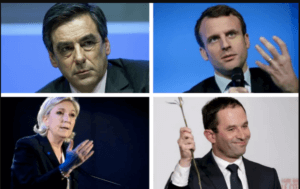
A. The socialists have pretty much devoured themselves. The party is bitterly divided between reformers and its old-school hard-left Brontosauruses. Hollande tried to please both wings and in doing so managed to infuriate them both, becoming the least popular president in French history. Then he held off, Hamlet-like, until December before deciding not to run for re-election. So the party had no time to unite around a new candidate until late January. Benoît Hamon only emerged as their candidate after the second round. The Socialists are the establishment, and France has had it with its establishment. Its liberal wing is rapidly defecting to Macron -- and Hamon isn't crazy enough for the really hard-left wing, who will probably go for Mélanchon.
Q. But what about Les Républicains? 
A. Penelopegate.
Q. Beg pardon?
Okay. During the primaries for Les Républicains, François Fillon -- who was prime minister under Nicolas Sarkozy -- surprised everyone by wiping the floor with his rivals, Nicolas Sarkozy and Alain Juppé. He claimed to be an ardent admirer of Margaret Thatcher and pledged to slash public sector jobs. He portrayed himself as the embodiment of a certain kind of French Catholic rectitude: very conservative, very traditional, and -- unlike his opponents (both known for their corruption and their legal problems) -- very upright. I didn't happen to like him, because like Marine Le Pen, he's too close to Putin and too hostile to the United States, but I could at least envision him as the next President of the Republic. So I figured that's what he'd be.
Fillon sold himself as Mister Clean, even offering God himself as his character reference: "I will never go to extremes," he promised, "because I am a Christian.” He wrote a whole chapter in his pre-election autobiography about his Catholic faith and how it distinguished him from the long line of corrupt politicians to which France has become bitterly accustomed. For conservative voters, he was obviously a credible alternative to Le Pen. He also claimed, with some plausibility, that he was the only candidate who could put together a coherent majority with which to govern after the legislative elections.
Then Penelopegate broke.
It seems that between 1986 and 2013, Fillon gave his wife a fake parliamentary job, for which she was paid 680,000 Euros out of public funds. His party pressured him for weeks to abandon his bid and let someone who could actually win it take his place, but he dramatically refused, even after he was formally charged.
Now the police are investigating the claim that he and his wife forged documents in an effort to justify the payments she received, and prosecutors are now extending the investigation to his children, who also appear to have received highly paid fake jobs from the state when they were still students. Last Tuesday, Penelope was formally charged with complicity in the abuse of public funds -- and she was also charged in connection with a salary she received from a literary magazine owned by one of her husband's billionaire friends, too. 
Needless to say, he's plunged in the polls. Voters seem to feel personally betrayed by him in a way I haven't seen before in France. His name just infuriates everyone I've spoken to about him. It's a bit as if they married a man who wasn't rich, wasn't good-looking, and wasn't charming, either, but at least, they thought, he'll be faithful -- and then they found him in bed with the babysitter. Last Saturday, protesters threw eggs at him.
So who's going to win?
If the election took place today, it would be Emmanuel Macron, a former economy minister who's never been elected to public office. He started his own party, called En Marche!, which means, "On the move!" or maybe, "Let's roll!" and no one's quite sure how he got this far, because he wasn't expected to go anywhere. He's a former investment banker who's never run in an election -- and he has no established party behind him, either. He's closely associated with Hollande, who made him his protégé, first as an advisor, then as his economy minister. And he's in a strange marriage with his high-school French teacher who's 26 years older than him, and with whom he became involved when he was still in high school, which everyone tries to pretend isn't relevant, but secretly thinks is really weird.
What does Macron stand for? 
Not being Le Pen and not being dogged by Penelopegate, mostly. And not being close to Putin. He believes traditional left-right distinction in politics are no longer relevant. Conventional wisdom is that he’ll siphon off voters who would usually vote for the Socialist Party. He proposes a reverse brain-drain policy to attract bankers and other businesses who may be obliged to leave London after Brexit and scientists who will lose funding under Trump to move to France. Recently, he's received a slew of endorsements from Socialist Party heavyweights who see him as the only one, at this point, who can keep Le Pen out of power. They see their own candidate, Benoît Hamon, as too much of a risk. 
What's wrong with Hamon?
No one's happy with the way the French economy's been working under Hollande, and he seems to want to double down on everything that hasn't been working. In 2012, he walked out on Hollande’s cabinet to protest the government’s modestly pro-business turn. He favors a universal minimum income, which attracted a lot of attention and pushed him through the second round of the Socialist Party primaries, but he's got the same problem as Le Pen, only in reverse: too many people here are seriously sick of the Socialists.
So it's down to those three? 
Basically, yes, though technically there are eleven candidates in the race, support for whom could affect the outcome at the margins, so it's important to keep an eye on them.
Who are they? 
A motley crew of commies, nuts, and misfits. Jean-Luc Mélenchon of La France insoumise, or Indomitable France, which includes the Communist Party, is the man who is somehow always in everyone’s photos of any given political protest or demonstration. It’s kind of a mystery and a miracle that he’s always in front and center no matter who took the photo or from what angle. His diet, he says, is largely based on quinoa. There’s Nathalie Arnaut of the fringe-Trotskyite Worker’s Struggle Party; François Asselineau of the Popular Republican Union (he quit the mainstream conservative UMP because he’s a passionate anti-American who deplores France’s alliance with the United States--French journalist Nicolas Hénin calls his party “the most pro-Putin party of France,” which is saying something); and Jacques Cheminade, of the Solidarity and Progress party, who is -- believe it or not -- a devotee of Lyndon LaRouche. (The FBI described him as “a foreign spy in the service of LaRouche.”) He represents, he says, the struggle against the “financial occupation” of Wall Street, the City of London, Brussels, and the IMF. There's Nicolas Dupont-Aignan, of Debout la France! or France Arise!, who believes himself to be the heir to Charles de Gaulle and otherwise has difficulty disambiguating his brand from the Le Pens' (he's against the Euro, thinks Brussels has stolen France’s sovereignty, and wants stricter control on immigration). There’s Jean Lassalle of Resist! He seems like a nice man. From a family of sheepherders in a tiny French village. I don’t quite know what he believes, politically, but he once went on a 39-day hunger strike to resist the closing of a factory. And finally, there’s Philippe Poutou, of the New Anti-Capitalist party, best known for Tweeting, "#KimKardashian 9 million euros of jewelry in her room? The redistribution of wealth is an emergency.” 
I see. That doesn't sound promising. Well, who's going to win the legislative elections?
No one knows. The National Front is hoping to win many MPs, and they might. The Republicains could rebound after they get over Fillon, probably after he's eliminated in the first round. The Socialists run the real risk of becoming irrelevant -- no one even knows who'd lead the party after Hamon's eliminated. There's no established En Marche! party machine, no grassroots, and no one's quite sure what it stands for.
So if Macron wins, he'll follow the lead of the party that takes the most seats, meaning he could be quite left-leaning or quite right leaning. He might have to cohabit with the Républicains, who might be willing to cooperate on some issues with the FN.
Or there could be chaos. It seems quite unlikely En Marche! could get an outright majority. So really, apart from being sure Le Pen won't win, I'm not sure what kind of government France is apt to have, and neither is anyone else. 
Any more questions? Live from Paris, I'll be in France all day to answer them.
------------------------------------------

Would you please consider contributing to my work? I'm crowd-sourcing my next book, Brave Old World: Europe in the Age of Trump. I appreciate even teeny-tiny donations: If you can only give a little bit, be assured that I'll hugely appreciate it.